 English
Does Using a VPN Get Your Claude Account Banned? The Real Cause + How to Avoid It

VPN Get Your Claude Account Banned?
if you have searched this phrase, you already know the frustration. You need a VPN to access Claude in the first place, but every time you use one, there is that nagging worry in the back of your head: is this the session that gets my account flagged?
The good news is that the situation is a lot more manageable than the rumors suggest. This article explains exactly how Claude’s detection system works, what the real triggers are, and what you should actually be doing to protect your account.
So let us talk about what is actually going on.
First Things First: VPNs Do Not Automatically Get You Banned
Anthropic has never published a rule that says using a VPN results in an automatic ban. The problem is that Claude’s risk system is automated, largely invisible, and does not explain its decisions. When someone gets banned while using a VPN, they naturally connect the two but the VPN is rarely the actual cause.
What the system actually runs is something closer to a risk score. It looks at your full picture: the quality of your IP address, the consistency of your account details, your login patterns, your payment information, and signals from your browser. A ban gets triggered when enough of those signals look suspicious at the same time, not because of any single action in isolation.
What Claude’s System Is Actually Checking
When you connect through a VPN, here is what matters to the detection system:
IP cleanliness: This is the biggest factor. Free VPNs and cheap paid VPNs recycle their IP addresses across huge numbers of users. Many of those IPs have already been flagged on other platforms for spam, abuse, or suspicious activity. When Claude’s system sees one of those IPs, your account starts the session already at a disadvantage before you have done anything at all.
Geographic consistency: Your account registration location, your payment method’s billing country, and your current IP location should broadly make sense together. If all three are pointing at different countries, the system reads that as unusual. It does not assume fraud, but it does raise your risk score.
Login stability: Connecting from the US today, Japan tomorrow, and Hong Kong the day after looks exactly like what compromised account activity looks like. The system cannot tell the difference between a legitimate user switching servers for speed and someone working through a list of stolen credentials. Stable, consistent location signals look normal. Erratic ones do not.
IP type: Datacenter IPs which is what most VPN providers give you by default are inherently more suspicious to detection systems than residential IPs. Residential IPs are harder to obtain but carry far less risk.
The Six Real Ban Triggers and What to Do About Each One
1. Sharing an Account With Other People
This is the most reliable way to get an account banned. Multiple people logging in from different devices and different IP addresses simultaneously is textbook compromised account behavior to an automated system. Groups trying to split a Pro subscription have reported losing the entire account within a week.
What to do: Register your own account. The cost of a subscription is significantly less than the hassle of losing an account and starting over.
2. Low-Quality Registration Details
Virtual phone numbers from SMS platforms and disposable email addresses work for registration until they do not. The issue is that these details have already been used by many different people on many different platforms. They carry a pre-existing risk score that puts your account in a weaker position from day one.
What to do: Use a real email address if possible. If you have to use a virtual number, be extra careful with everything else on this list, since you are already starting with one strike against you.
3. Payment Details That Do Not Match Your IP Location
Subscribing to Claude Pro while connected to a US server, but paying with a card registered to a billing address in another country, looks like a cross-border fraud attempt to automated systems.
What to do: When handling anything related to billing like subscribing, upgrading, updating payment details. Connect through a VPN server in the same country as your payment method’s billing address. Then you can switch back to your normal server for regular use.
4. Browser Fingerprint Leakage
Your browser sends a surprising amount of information beyond your IP address: system language, time zone, installed fonts, plugins, screen resolution. Certain browsers popular in Chinese-speaking markets are particularly detailed in what they expose. When that fingerprint data points to a different location than your IP, the system notices the contradiction.
What to do: Use Chrome or Edge for Claude. Set the browser language to English, make sure the system time zone matches your VPN server location, and avoid installing unusual plugins or extensions.
A Practical Setup That Actually Works
If you want to use Claude through a VPN without constantly worrying about your account, here is a setup that addresses all the main risk factors:
Choose a paid VPN with clean IPs: The difference between a clean residential or dedicated IP and a recycled datacenter IP is the difference between looking like a normal user and looking like a bot farm. It is worth paying for.It is worth paying for. If you are not sure where to start, we put together a breakdown of the most practical paid options available right now. You can read the full comparison in our 2026 VPN monthly plan guide.
Never share your account: Not with family, not with friends, not with anyone. One account, one person.
Handle billing carefully: Any time you need to do something related to payment, connect through a server in the same country as your billing address first.
Use a clean browser setup: Chrome or Edge, English language, matching time zone, no exotic plugins.
Do not use the free tier of a VPN for accounts you care about: Free tiers exist for testing. For actual regular use, the IP quality is simply not reliable enough.
FAQ
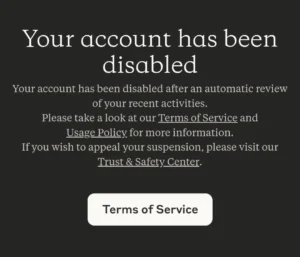
If I get banned, is there any point in appealing? It depends on why you were banned. If the trigger was a payment issue or an automated false positive, contacting Anthropic support through the official channel is worth doing and sometimes results in resolution. If the ban was behavioral like account sharing, suspicious login patterns , the chances are lower, but it is still worth submitting a proper appeal with context.
Does a residential VPN IP completely eliminate the risk? It eliminates one major risk factor. IP cleanliness is significant, but it does not override everything else. Account sharing and payment mismatches can still cause problems regardless of IP type. Think of clean IPs as removing one item from the risk stack, not as a complete solution on its own.
Is it safe to use a free VPN for Claude at all? For a quick session where you are not doing anything account-sensitive, the risk is lower. For regular use, for billing, or for an account you actually want to keep long-term, free VPN IPs are not reliable enough. The cost of losing the account is higher than the cost of a basic paid VPN subscription.
What is the single most important thing to avoid? Account sharing. Nothing else on this list comes close in terms of how reliably it triggers bans. Every other risk factor on this list is manageable. This one is not.